









Tricycle Sector at a Crossroads: Drivers’ Welfare and the Future of Philippine Mobility
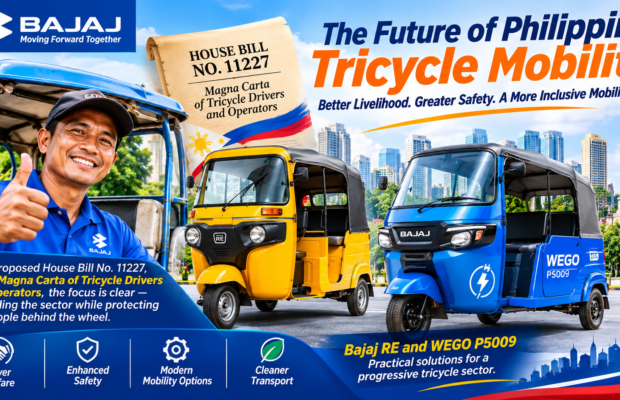

Tricycles remain an indispensable part of Philippine transportation, connecting communities, providing accessible mobility, and serving as a livelihood for thousands of Filipino drivers and operators. As the sector faces rising operating costs and evolving transportation demands, proposed House Bill No. 11227, or the Magna Carta of Tricycle Drivers and Operators, seeks to address key concerns involving workers’ rights, social protection, road safety, streamlined government processes, and opportunities for more efficient and cleaner transportation. The proposed measure underscores the importance of recognizing tricycle drivers and operators not only as essential transport providers but also as workers whose welfare and economic security deserve greater attention.
Alongside policy initiatives, vehicle innovation and practical mobility solutions can also contribute to the evolving needs of the tricycle sector. Bajaj offers options designed for daily passenger transport, including the Bajaj RE, powered by a 236cc engine and equipped with practical features such as extended seating and a lighted fuel gauge, and the Bajaj WEGO P5009, an electric alternative featuring a 9.2 kWh battery, a 4.5 kW motor, and a claimed range of up to 212 kilometers on a single charge. These options provide operators with alternatives to consider based on their routes, operating costs, maintenance requirements, energy access, and livelihood needs, recognizing that affordability and dependable performance remain essential considerations for those who rely on tricycles for income.

The future of Philippine tricycle transportation will require more than new vehicles or legislation alone. Access to affordable financing, dependable maintenance, charging infrastructure for electric vehicles, road safety, stronger worker protections, and responsive government policies all play a role in making progress sustainable and inclusive. As discussions surrounding the Magna Carta of Tricycle Drivers and Operators continue, collaboration among policymakers, local governments, transport communities, and mobility providers will be vital in ensuring that modernization translates into meaningful improvements in the lives of drivers, operators, and commuters.


0 comments